
Anthony Licciardello | July 1, 2026
Ocean Grove, NJ
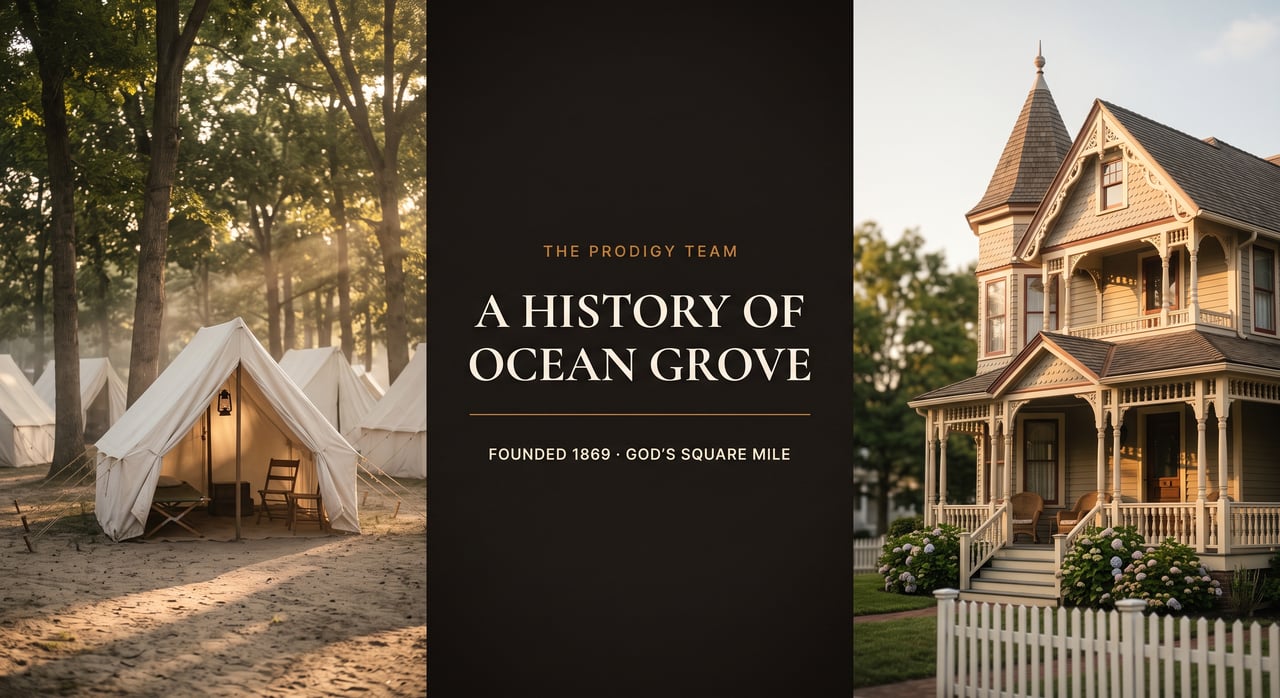
History & Preservation · Ocean Grove, NJ
On July 31, 1869, a small group of Methodist ministers pitched their tents on a shaded, well-drained stretch of the New Jersey shore and resolved to build something permanent there. They called it Ocean Grove. What began as a seasonal prayer camp became, within a few decades, a planned Victorian town of extraordinary completeness — and the unusual arrangements those founders set in motion still govern the place today. To understand why Ocean Grove looks and works the way it does, you have to start at the beginning.
Walk the Grove's history with us — Watch on YouTube →
This is part of our history and preservation series. For the whole town, start at the complete Ocean Grove guide.
1869 · Founded
Methodist ministers pitch tents and name the town.
1870 · Charter
The state charters the Association — and the land lease is born.
1894 · Auditorium
The Great Auditorium rises as the town's beating heart.
1979 · The Reckoning
A court ends the Association's civil government.
It began as a circle of canvas tents. It became a Victorian treasure.
Ocean Grove grew out of the camp-meeting movement that swept the 19th-century Northeast — open-air revivals where the faithful gathered for days of worship. Reverend William B. Osborn dreamed of a permanent version by the sea, and with Reverend Ellwood H. Stokes and a band of fellow Methodist clergy, he found his shaded, healthful spot on the shore. They named it Ocean Grove that July, and by December had organized the Ocean Grove Camp Meeting Association to run it. From the first season, summer worshippers pitched tents around the preaching ground — the origin of the canvas Tent City that still rings the Auditorium today.
In 1870 the New Jersey Legislature granted the Association a charter, with sweeping authority to hold its square mile of land and to provide the community's government and services — ordinances, a police force, a court, sanitation, and more. The founders laid the town out deliberately, one of the earliest planned communities in America, with the grand green of Ocean Pathway aimed at the auditorium grounds and streets named for scripture. And they made a fateful choice that endures: the Association kept ownership of all the land, leasing lots to residents rather than selling them. The first cottage went up that same year. If you've read our land-lease explainer, this is where that 150-year arrangement began.
For decades the Grove flourished as what admirers called the “Queen of Religious Resorts.” Its rhythms were singular: gates closed on the Sabbath, no carriages or, later, cars moved on Sunday streets, and the beach itself rested — so visitors tended to come for a week or a season rather than a rowdy weekend, knitting a remarkably close community. Of the Sunday rules, Stokes once declared there was “no human probability that these rules will ever be revoked.” Crowning it all, the Great Auditorium opened in 1894, a vast wooden hall whose stage drew U.S. presidents — among them Grant, Garfield, McKinley, Theodore Roosevelt, Wilson, and later Nixon — along with famous preachers and performers.
Did You Know
Six U.S. presidents have appeared on the Great Auditorium's stage — Grant, Garfield, McKinley, Theodore Roosevelt, Wilson, and Nixon.
For over a century, a religious association governed a town — making laws, running a court, and fielding police. Residents periodically chafed at it; a short-lived attempt to incorporate a secular Borough of Ocean Grove in 1920 was struck down by 1921. The decisive break came with the 1979 New Jersey Supreme Court decision in State v. Celmer. A motorist arrested by Ocean Grove's police challenged the whole arrangement as an unconstitutional establishment of religion — and won. The court ordered the Association's governmental powers transferred to Neptune Township, and by the early 1980s the Grove's distinctive blue laws, police force, and municipal court gave way to ordinary township government. What survived was the thing the founders most cared about protecting: ownership of the land, and the lease beneath every home.
Like many old resorts, the Grove fell on hard times through the mid-20th century, its grand cottages fading and its crowds thinning. But the same isolation that caused the slump also spared its architecture from the wrecking ball — and when its listing on the National Register of Historic Places affirmed what it was, a revival followed. Through the 1980s and 1990s, a determined homeowners' movement and a wave of new, diverse year-round residents restored the Victorians one porch at a time, reopened inns and cafes, and turned “shabby” back into “sought-after.” That renaissance is exactly why the Grove is so prized today — a hard-won inheritance now changing hands at record demand.
“
From the Broker
When you buy in Ocean Grove, you're not just buying a house — you're stepping into a story that's survived a court fight, a long decline, and a full comeback.
Ready to write your chapter in the Grove?
A century and a half of history is part of what you buy here. The Prodigy Team helps buyers — many from New York and Staten Island — understand the Grove's story, its land lease, and its character before they choose a home. We work both sides of the water.
Anthony Licciardello, Broker, The Prodigy Team · 718-873-7345
See What Your Ocean Grove Home Is Worth →
It was founded on July 31, 1869, by Methodist Episcopal clergy led by Reverend William B. Osborn and Reverend Ellwood H. Stokes, as a permanent seaside camp-meeting community. The state chartered the Ocean Grove Camp Meeting Association in 1870.
The 1870 state charter granted the Association broad municipal powers to run Ocean Grove as a religious community, including ordinances, a police force, and a court — an arrangement that lasted until the courts ended it.
It was the 1979 New Jersey Supreme Court case in which a motorist arrested by Ocean Grove police challenged the Association's governmental authority as an unconstitutional establishment of religion. The court agreed, and the Association's municipal powers passed to Neptune Township by the early 1980s.
Very much. The Association still owns all the land and leases it to homeowners, the town remains dry, and its preserved Victorian character — rooted in those 1869 origins — is exactly what makes it so desirable now.
Prodigy Real Estate is an innovative real estate company offering high-end video production, home valuation services, purchasing, and home sales. Serving New York and New Jersey.