
Anthony Licciardello | March 30, 2026
gre
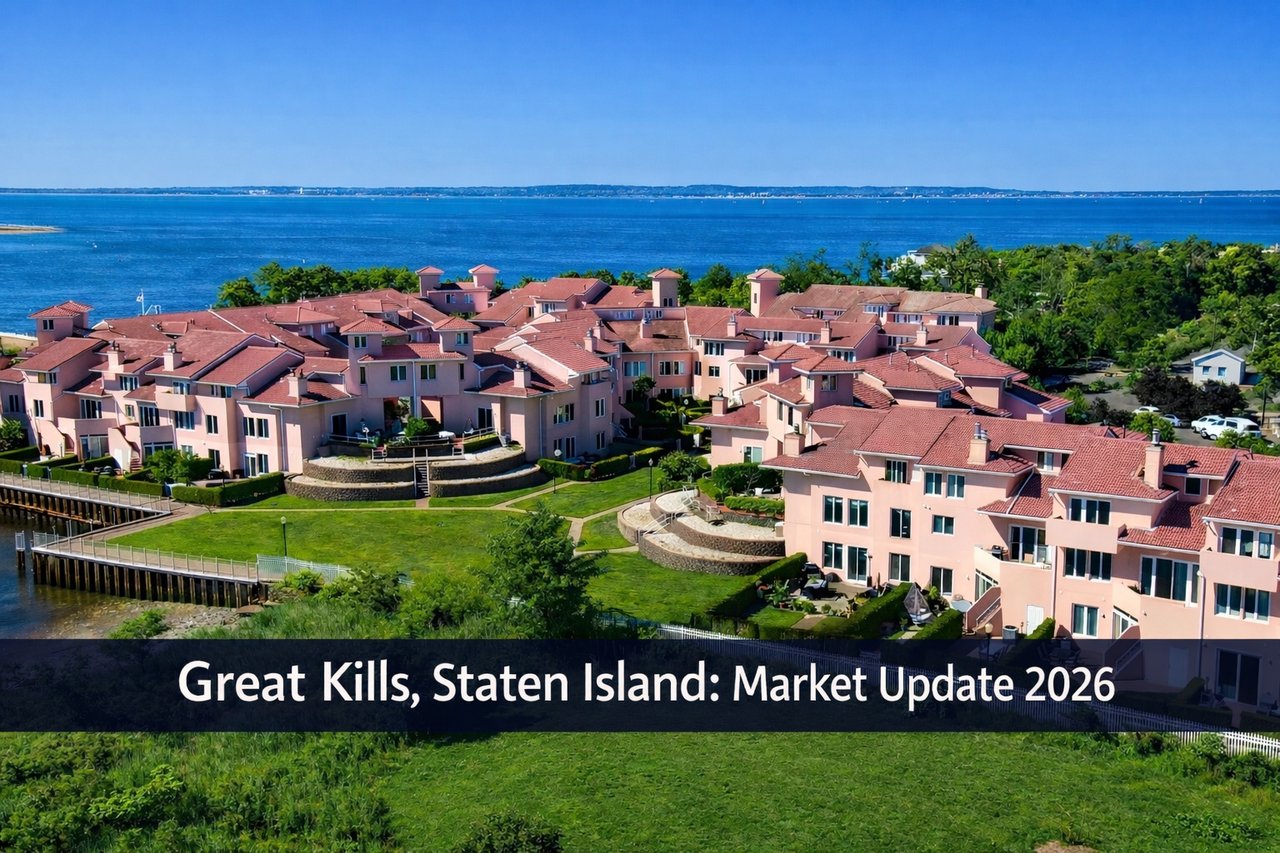
Permit filings, waterfront demand, and a clear escalation cycle are quietly pushing Great Kills into a new price era
Great Kills doesn't make a lot of noise. There are no tower cranes on the skyline, no major mixed-use developments breaking ground, no headlines. What's happening here is subtler — and in some ways more meaningful. Block by block, older homes are being expanded, repositioned, and replaced. Buyers are paying premiums for the results. And the permit data from the New York City Department of Buildings tells you this is only gaining momentum.
This is a neighborhood mid-transformation. The harbor is a draw. The park access matters. The housing stock is aging in ways that create real opportunity — for buyers who know where to look, sellers who understand what their updates are worth, and investors who can read a permit filing the way a trader reads a chart.
The headline numbers tell a tight, fast-moving market. Homes are selling above asking price, inventory is thin, and the median sits just under $800,000. That's not an accident — it's the result of sustained reinvestment activity compressing supply while demand stays strong. For context on how this fits the broader Staten Island picture, see our Staten Island seller's guide.
A list-to-sale ratio above 100% means buyers are consistently offering over asking price. In a market with under two months of inventory, that's not surprising — but it's a number sellers should know going in, and buyers should plan around. Competitive offers are the expectation here, not the exception.
"Homes are selling in 25 days and closing above asking. That's not a hot streak — that's a structural supply problem that shows no signs of resolving."
Permit filings are one of the most underused data sources in residential real estate. Most buyers never look at them. That's a mistake — especially in a neighborhood like Great Kills, where the permit activity right now is a direct preview of what the resale market will look like in 12 to 24 months.
Here's a plain-language breakdown of what each filing type means, and what's been moving through the system in Great Kills recently.
ALT-1 Filing
Major Alteration
Structural changes — additions, expansions, layout overhauls. The home being filed on is not the same home that will hit the market. This is full property repositioning.
ALT-2 Filing
Interior Renovation
No structural change but meaningful modernization — kitchens, bathrooms, systems. These properties come to market upgraded and priced to reflect it.
Demo Permit
Teardown Signal
The existing structure is coming down. A builder decided the land is worth more than whatever sits on it. One of the strongest signals of rising land value in any neighborhood.
Multiple active permits here, including a construction fence and general construction filing. When a property gets a construction fence, the scope of work is significant enough that the site needs to be secured — this isn't a weekend renovation. It's a strong signal of investor or builder involvement looking to reposition the property from the ground up. Watch this address.
A major alteration filing covering building expansion and layout modification. This home is being made bigger and better. The recent close at 63 Hillside Terrace — $720,000 in more original condition — tells you where the floor is on this block. When 74 comes to market post-renovation, it won't be trading anywhere near that number. The ALT-1 filing is the gap between those two prices.
An ALT-2 renovation covering interior systems and finishes — the kind of upgrades buyers notice immediately and pay for. The recent close at 42 Tennyson Drive for $1,050,000 is the blueprint: a modernized, expanded home near the waterfront breaks into a completely different price tier. This filing is that same strategy at work, one street number apart.
This is the most telling filing in the current batch. A demo permit means a builder looked at the existing structure, compared it against what renovated homes are selling for on the same block, and decided the land was worth more than whatever sat on it. The recent close at 27 Armstrong Avenue — $910,000 for a renovated, repositioned home — is exactly the comp that made that math work. Armstrong Avenue is a block to watch.
Sales data is most useful when you read it alongside what's happening at the permit level. On their own, these four closes are just numbers. Together with the filing activity, they map out exactly how Great Kills is escalating — and where the next tier of value is being built right now.
42 Tennyson Drive
$1,050,000
Expanded home near the waterfront. This is the ceiling that ALT-1 expansion activity across the neighborhood is chasing. Waterfront proximity combined with added square footage is the combination that breaks into seven figures in Great Kills.
27 Armstrong Avenue
$910,000
Renovated and modernized. This is the exit comp that justified the demolition filing next door at 89 Armstrong. A builder saw a repositioned home close at $910,000 on the same block and made a decision about the land next door. The permit filing followed.
18 Fieldway Avenue
$835,000
Fully renovated interior, no structural expansion. This is the ALT-2 story in sale form — interior upgrades alone cleared $835,000. Modernization without adding square footage is still producing real returns here, which isn't always the case in every market.
63 Hillside Terrace
$720,000
More original condition — no significant renovation. This is the floor, and it's a strong one. Baseline demand in Great Kills holds at $720,000 before a dollar of work is done. That answers the first question any buyer or investor should ask: is the underlying demand real? Yes.
"The four-sale spread says everything: $720K for original condition, $1.05M for expanded and waterfront-adjacent. That $330,000 gap is what every active permit in this neighborhood is chasing."
What's happening in Great Kills is a self-reinforcing cycle. Understanding how it works explains where prices are going — not just where they've been.
It starts with baseline demand. Great Kills Harbor, the marina, the park, the manageable commute into the city — these fundamentals keep buyers interested and hold the floor. That's why even untouched homes clear $720,000. Once buyers see that floor, investors follow. They pull ALT-2 permits, modernize interiors, and sell into a market that rewards the upgrade — $835,000 at Fieldway Avenue proves it. Those results attract the next wave: builders who want more than renovation returns. They file ALT-1 expansions, add bedrooms and square footage, and push into the $900,000-plus range. At the top of the cycle, someone looks at a dated home on a block where renovated properties are trading near seven figures and files a demolition permit. The land is worth more than the structure. New construction follows, sets a new comp ceiling, and the next round of renovators calibrate to it.
All four stages are active in Great Kills right now — simultaneously — visible in the permit filings and the recent sales data above. For buyers and investors who understand this dynamic, the question becomes straightforward: where do you want to enter the cycle? For more on what makes this neighborhood compelling for long-term ownership, see our Great Kills neighborhood profile.
If You're Selling
Renovations and expansions are directly translating into higher closes — the data proves it. If you've updated your home, you're not just selling a house. You're selling a comp for the next buyer on your block. Price accordingly.
Timing is favorable. A 25-day average and a 101–103% list-to-sale ratio means well-positioned listings are not sitting. The market is meeting sellers more than halfway right now.
If You're Buying
Look for homes with permit potential — properties where an ALT-1 expansion or ALT-2 renovation lets you participate in the same value escalation cycle the recent sales data maps out. The floor is established. The upside is in what you do with the asset.
Track blocks with active filings. Hillside Terrace, Tennyson Drive, and Armstrong Avenue are all showing activity right now. Where the permits are today is often where the strongest comps are 18 months from now.
Thinking About Great Kills?
Prodigy tracks permit activity, sales comps, and neighborhood trends across Staten Island so our clients can make better-informed decisions — whether they're buying, selling, or evaluating an investment. If Great Kills is on your radar, let's talk specifics.
Connect With The Prodigy TeamProdigy Real Estate is an innovative real estate company offering high-end video production, home valuation services, purchasing, and home sales. Serving New York and New Jersey.