
Anthony Licciardello | April 2, 2026
Brick, NJ
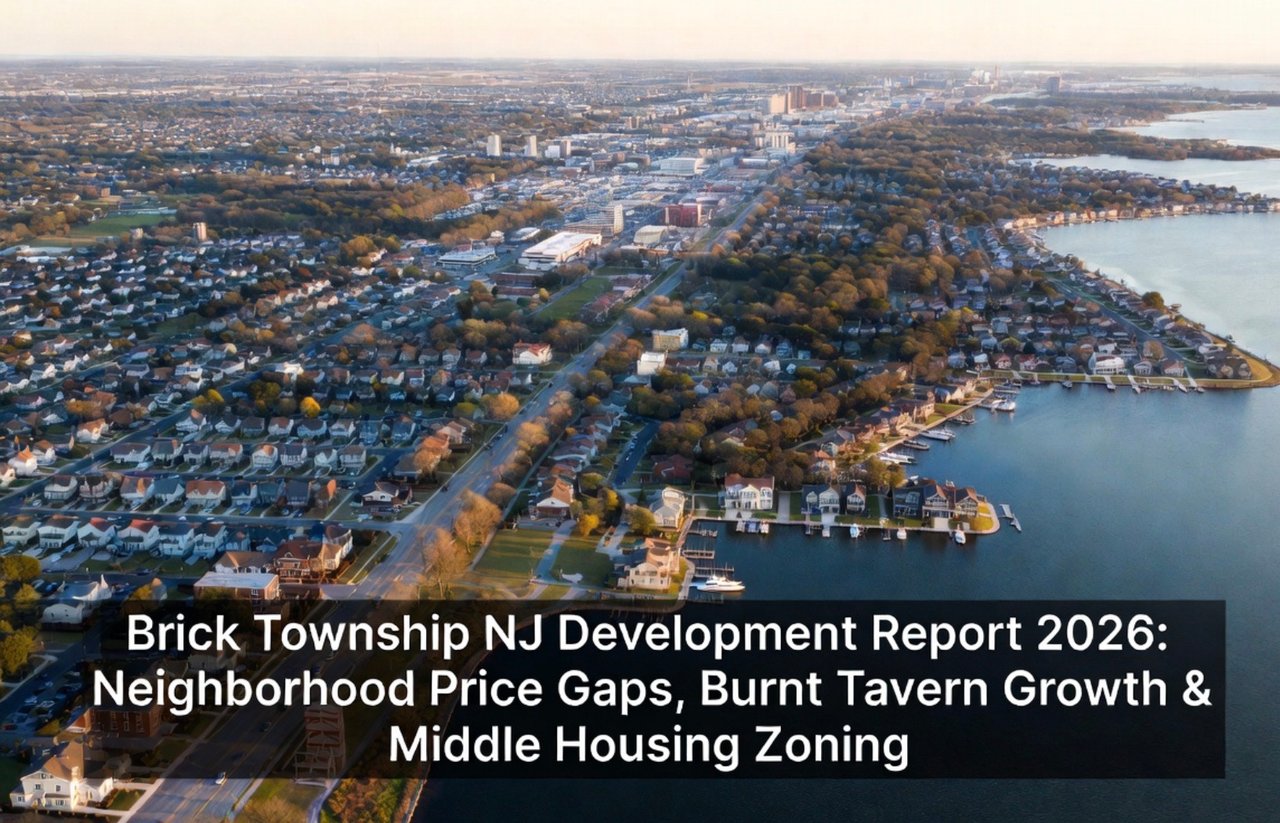
Brick Township is not a one-price market. It behaves more like a collection of submarkets tied together by one municipal government — waterfront enclaves, inland family neighborhoods, adult communities, commercial corridors, and barrier-island-adjacent pockets all trade on different logic. Its 2026 development story is being driven by two forces at once: a still-active resale market with meaningful neighborhood-level price gaps, and a major affordable-housing compliance push now reshaping zoning from the ground up.
February 2026 Market Snapshot · Brick Township, NJ
$514,633
Median List Price
$482,083
Median Sale Price
208
Homes for Sale
28
Days to Pending
0.998
Sale-to-List Ratio
38.8%
Sold Over List
Sources: Zillow, Realtor.com, Redfin · Data reflects January–February 2026 activity
01
The broad market is still active, but not uniformly overheated. Zillow's February 2026 data shows 208 homes for sale, 64 new listings, a median list price of $514,633, and a median sale price of $482,083 based on January closings. Homes are going pending in 28 days on average, with a 0.998 sale-to-list ratio. That last number is revealing: 38.8% of sales closed over list while 44.8% closed under — a spread that tells you buyers are competing hard in some pockets and winning concessions in others.
Realtor.com puts the February median a bit higher at $522,000 with 40 days on market, calling the market balanced. Redfin tracks a lower $475,000 sale price, 41 days on market, and homes closing roughly 0.2% under list. The gap between those three numbers isn't a conflict — it reflects different data methodologies and different slices of Brick's diverse housing mix. A township this large, with adult communities, waterfront compounds, and standard suburban streets all folded in together, will always produce headline figures that obscure more than they reveal.
02
Brick's value map is dramatically more nuanced than any single median suggests. The township spans everything from a $3.3 million neighborhood to communities trading comfortably under $500,000 — and those aren't outliers. They are Brick's actual range. The neighborhood-level data from Realtor.com makes that spread undeniable.
| Neighborhood | Median Price | Tier |
|---|---|---|
| Mantoloking Estates | $3,324,000 | Luxury waterfront / barrier-island |
| Chestnut Estates | $1,024,500 | Premium inland |
| Country Place | $749,000 | Premium inland |
| Greenville | $719,500 | Established suburban |
| Fairways at Lake Ridge | $575,000 | Planned / community housing |
| Lake Ridge | $475,000 | Adult / community housing |
Source: Realtor.com neighborhood data, February 2026
Zip-code data reinforces the same tiering. 08724 sits at $515,000 and 08723 at $511,450 — squarely in Brick's mainstream range. Move toward the barrier island and the numbers change fast: 08735 at $1.049 million, 08736 at $1.599 million, 08730 at $1.845 million, and 08738 at $4.7725 million. Not all of those are wholly within Brick's municipal boundaries, but they show exactly how quickly proximity to the water resets the price equation.
The practical takeaway: in Brick, value tracks four things more than anything else — water access, flood exposure and rebuild complexity, neighborhood identity, and housing type. Adult-community, standard suburban, and premium waterfront product follow different pricing curves even when they share the same township address. Understanding those four variables is what separates a well-positioned Brick purchase from one that gets misread against the wrong comparable set. It's a dynamic we cover closely in our Monmouth County market analysis.
03
Waterfront and barrier-island-adjacent. This is where pricing detaches entirely from the township median. West Mantoloking–style product, lagoon homes, and premium waterfront streets trade from high six figures to multi-millions depending on bulkhead condition, boating depth, flood-zone classification, and rebuild quality. Mantoloking Estates is the clearest data anchor — $3.324 million median, $1,237 per square foot, and roughly $6,000 per month in median rent — but there is a wide range within that tier, and condition and positioning within it matter enormously.
Established inland family neighborhoods. This is where buyers prioritize layout, yard size, renovation quality, and commute convenience over lifestyle branding. Greenville, Country Place, and similar pockets consistently outperform the township median without needing water to justify it — they trade on substance: lot size, housing condition, school convenience, and neighborhood stability.
Adult communities and planned neighborhoods. Lake Ridge and Fairways at Lake Ridge help anchor Brick's overall median. These communities trade on affordability, maintenance profile, and amenity access rather than land scarcity. They are not where appreciation is most dramatic, but they attract a consistent, specific buyer profile — and they price accordingly.
Commercial corridors and redevelopment zones. These are not Brick's highest-priced resale neighborhoods today. But they matter disproportionately for future value creation because they are where zoning flexibility and affordable-housing compliance are being concentrated — particularly along Burnt Tavern Road and the township's new middle-housing overlay areas.
04
Brick's biggest 2026 development story is not a luxury subdivision. It is the township's affordable-housing compliance framework and the zoning changes it produced. New Jersey's Round 4 Mount Laurel process calculated a present-need obligation of 149 units and a prospective-need figure of 360 units for Brick. The township initially argued its realistic prospective need was just 29 units based on available developable land. After challenges, Brick adjusted its position to 322 units — a number that directly triggered the ordinance changes adopted in March 2026.
On March 10, the township council passed second readings on an ordinance replacing portions of Chapter 245 to address affordable-housing requirements, alongside separate measures for a Middle Housing Overlay Zone and a new Burnt Tavern Multifamily Zone. Those three ordinances together represent the most significant shift in Brick's zoning posture in years, and they are not symbolic — they are entitlement infrastructure that development will move through.
Burnt Tavern Road: the clearest active project signal.
The highest-profile site-specific proposal is along Burnt Tavern Road, where the township's settlement framework allows a 264-unit complex with 53 affordable units. Brick's official legal notice confirms the council adopted an ordinance adding Section 245-77 — the "Burnt Tavern Multifamily Zone (BTMF)" — on March 10, 2026. The Housing Element also identifies specific Burnt Tavern parcels in its overlay-lot appendix, including Block 1108, Lots 16 and 17, tied to the Anchor Concrete / 975 Burnt Tavern Road site. This is not a conceptual proposal — it has a zone, it has a parcel, and it has a unit count attached.
Middle Housing Overlay Zone: potentially the more important long-term change.
The Middle Housing Overlay Zone may ultimately matter more than Burnt Tavern on its own. Brick's Housing Element describes the overlay as an effort to enable more attainable housing along transportation corridors without the kind of high-rise product the township explicitly says does not fit here — and the plan is direct about that. Five-story monolithic apartment buildings are out. What the overlay permits instead: carriage houses, bungalows, cottages, detached compact houses, duplexes, townhouses, rowhouses, garden apartments, multiplexes up to five units, and live/work buildings.
The overlay is expected to cover roughly 72 acres across 50 parcels, mostly along major thoroughfares, at about 10 units per acre. Brick is signaling a suburban-medium-density strategy — more units, but in forms meant to read as neighborhood housing rather than apartment blocks. That is a meaningfully different approach from what you see in Shore towns that have leaned into vertical redevelopment, and it reflects what Brick's political environment will actually support.
05
On March 24, 2026, Brick also adopted an ordinance requiring annual inspections for a Rental Certificate of Occupancy and amending related fee schedules. The stated intent is straightforward: keep rental properties safe and code-compliant through consistent, recurring inspection rather than complaint-driven enforcement.
That matters more in Brick than it would in a purely owner-occupied town. Brick has meaningful seasonal, waterfront, and investor-owned rental activity — homes that cycle through tenants, short-term rentals operating in compliance-gray areas, and investor math that depends on seasonal or repeat tenancy. Tighter annual inspection requirements raise the operational burden for landlords in that segment. They do not automatically suppress values, but they do change the compliance calculus for anyone buying in Brick primarily for income. This is something investors need to price in, and it fits a broader pattern of tightening Shore market rental regulation we have tracked across Ocean and Monmouth counties.
06
Brick's value story in 2026 is splitting into three distinct tracks running at the same time.
Track one is the premium waterfront and coastal-adjacent market. Scarcity, water frontage, and rebuild potential keep values elevated far above township medians regardless of what the broader market does. Mantoloking Estates is the data anchor, but the dynamic applies across Brick's lagoon streets and bay-facing inventory. This segment does not behave like the rest of the town, and it shouldn't be analyzed like it does.
Track two is the stable suburban and community-housing market. This is where most Brick buyers and sellers are operating. Pricing here is firmer than pre-pandemic norms but more negotiable than the town's hottest waterfront pockets. The Realtor.com balanced-market characterization and the near-list closing data from Zillow and Redfin both point in the same direction: competitive but not chaotic.
Track three is the corridor redevelopment market. Zoning changes along major roads — the BTMF zone, the Middle Housing Overlay — could gradually create a new class of product in Brick: middle housing, inclusionary multifamily, and mixed residential forms in places that historically traded as ordinary commercial or low-intensity sites. That may not reset township values overnight. But it will reshape how buyers, investors, and developers price certain corridors over the next several years. That is worth watching closely, and it is the part of Brick's story that most market-watchers are still underweighting.
Bottom Line
Brick Township is one of the more nuanced Shore markets precisely because it combines mainstream suburban housing with true luxury waterfront pricing and now a more visible affordable-housing and redevelopment agenda. Lake Ridge is not Greenville. Greenville is not Chestnut Estates. None of them trade like Mantoloking Estates or premium waterfront inventory. The February 2026 stats show a still-active market around the low-$500,000s overall — but neighborhood data makes clear the median is a blended average of very different realities.
On the development side, the Burnt Tavern multifamily zoning, the new Middle Housing Overlay Zone, and the shift to annual rental inspections tell a coherent story: Brick is entering a more entitlement-driven phase. Future value here will be tied not just to location, but to whether a specific site sits inside one of the township's evolving zoning and compliance frameworks. That is a meaningful change in how this market works — and it is worth understanding before buying, selling, or investing in Brick in 2026. Prodigy covers both the Ocean County market and NJ Shore development trends in depth — reach out if you want a sharper read on how these shifts apply to a specific property or corridor.
Prodigy Real Estate is an innovative real estate company offering high-end video production, home valuation services, purchasing, and home sales. Serving New York and New Jersey.